
Digital Agriculture Marketplace Development
Businesses exploring a digital agriculture marketplace usually want a product that customers understand instantly while the operation behind it stays manageable. For this model, marketplace operations and a clear admin panel shape most of the development scope.
CloneAppTech designs and builds original apps, dashboards and integrations around your brand, pricing and operating rules.
Business model
How a digital agriculture marketplace makes money
Most digital agriculture marketplace projects follow one of three models: input marketplace, produce trading, farm management saas. Subscriptions for large farms, FPOs or agribusinesses. The right choice depends on who owns inventory or supply, how you earn per transaction and how much operational control you want.
Input marketplace
Margins or commission on seeds, fertiliser and equipment.
Produce trading
Connect farmers to buyers; fees on trades.
Farm management SaaS
Subscriptions for large farms, FPOs or agribusinesses.
Target audience & use cases
Who this solution is for
- Institutions and public bodies
- Industry specialists with domain expertise
- Innovators working with new technology
- Existing agriculture & agritech businesses replacing manual or outdated systems
Core application features
What the product needs on day one
- Vendor onboarding with document verification
- Per-vendor commission and payout rules
- Vendor-level catalogue and order dashboards
- Ratings that affect vendor visibility
- Local-language UI
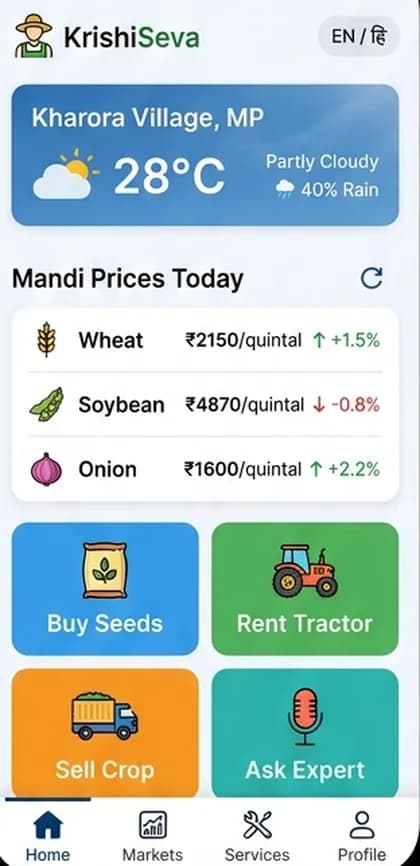
- Mandi price feeds
- Weather integration
- Equipment booking
- Produce listing
- Field data capture
Apps & user roles
Features for every role involved
Only the roles that apply to this business model are included.
01
Farmer app
- Vernacular, voice-friendly interface
- Buy inputs or rent equipment
- Sell produce and see prices
- Advisory and weather
02
Buyer / dealer app
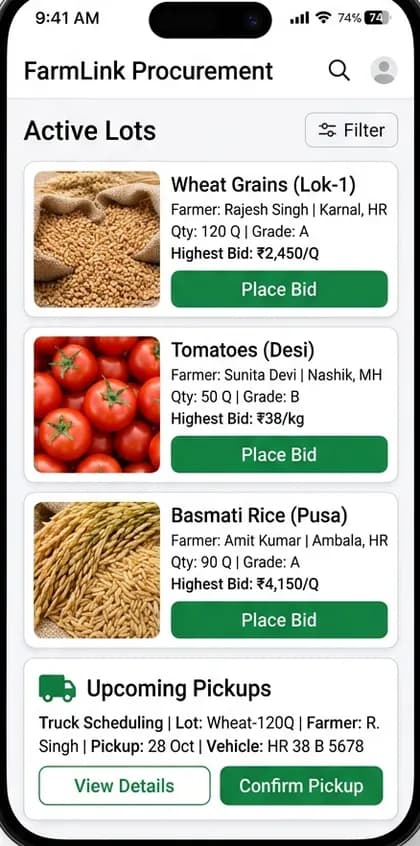
- Procurement and bids
- Quality and logistics
03
Admin panel
- Price feeds
- Agronomist content
- Credit and payments
Workflow
How a typical marketplace operations flow runs
- 1
Farmer registers with land and crop details
- 2
Advisory and weather guide activities
- 3
Inputs or equipment are ordered
- 4
Produce is listed or contracted
- 5
Buyer collects and payment settles
Technology & integrations
Technical considerations
- Split payments and vendor payouts are easiest with a gateway that supports marketplace settlements; otherwise a ledger and manual payout process are required.
- Offline-first design for rural networks.
- Satellite or IoT data for crop monitoring.
- Voice and IVR alternatives.
- Lightweight apps for entry-level phones.
Customisation options
Make it yours
- Your brand identity, colours, typography and app icon
- Business rules for marketplace operations configurable from the admin panel
- Languages, currencies and regional tax settings
- Payment gateways and payout methods available in your country
- Commission, fee or subscription structure
- Optional modules added in later phases
Development scope
A typical first release includes the farmer app, buyer / dealer app, admin panel, a backend API, cloud hosting setup and the integrations for marketplace operations. Optional modules are planned into later phases.
Factors affecting pricing
What drives the cost of a digital agriculture marketplace
Medium-level projects typically start from ₹1.5 Lakh ($1,800). Your exact quote depends on these factors.
- Vendor management and split settlements
- Marketplace vs. management
- Data sources (weather, satellite, prices)
- Languages
- Logistics
- IoT integration
Project phases
Estimated phases, testing and launch
Durations are agreed after discovery; testing, deployment and maintenance are part of every plan.
Phase 1
Discovery
Confirm the digital agriculture marketplace business model, user roles and must-have features.
Phase 2
Design
Original user flows and interface design for each app and the admin panel.
Phase 3
Build
Mobile apps, backend APIs and marketplace operations.
Phase 4
Test
Functional, device and load testing of critical flows.
Phase 5
Launch
Store submission, cloud deployment and monitoring.
Phase 6
Improve
Maintenance and roadmap features based on real usage.
FAQs
Digital Agriculture Marketplace questions
How much does it cost to build a digital agriculture marketplace?+
Cost depends on the roles you need (farmer app, buyer / dealer app, admin panel), the depth of marketplace operations, integrations and platforms. Medium-level builds typically range from ₹4–10 Lakh ($4,800–$12,000) for multi-role apps, and from ₹1.5 Lakh ($1,800) for a focused first release; we confirm the exact quote after reviewing your requirements.
How do vendors get paid?+
Through scheduled payouts after commission is deducted, either automatically via a marketplace-capable gateway or through a reconciled payout report.
Can you integrate sensors?+
Yes, IoT soil and weather sensors that expose data can be integrated.
Related
Explore related solutions
Related app models
Related categories
Development services
Next steps
Free consultation
Planning a digital agriculture marketplace?
Tell us your market and must-have features. We'll suggest a realistic first release for your digital agriculture marketplace and the next steps.