Gojek Clone App Development
A Gojek-style super app starts with ride-hailing and adds food delivery, parcels, payments and on-demand services, all sharing one customer account, one partner network and one wallet. The architecture must treat each service as a module that can launch city by city.
It is inspired by the publicly known Gojek business model, but it is not affiliated with, endorsed by or a copy of Gojek. CloneAppTech designs and builds original apps, dashboards and integrations around your brand, pricing and operating rules.
Business model
How a Gojek-style app makes money
Each module earns its own commissions and fees, while the shared wallet and loyalty program increase cross-service usage. Partners can earn from several services, which improves their utilisation.
Mobility-led super app
Rides form the daily habit; delivery and payments are cross-sold.
Payments-led super app
A wallet or UPI app adds commerce, tickets and bill payments.
Regional services aggregator
Local vendors and service providers onboard into multiple categories.
Target audience & use cases
Who this solution is for
- Regional mobility companies expanding into delivery
- Payment apps adding services
- Entrepreneurs targeting cities without a dominant super app
Core application features
What the product needs on day one
- Vendor onboarding with document verification
- Per-vendor commission and payout rules
- Vendor-level catalogue and order dashboards
- Ratings that affect vendor visibility
- Modular service architecture
- Shared wallet and ledger
- Mini-app or module framework
- Unified notifications
- City-level configuration
- Partner multi-role support
Apps & user roles
Features for every role involved
Only the roles that apply to this business model are included.
01
Customer app
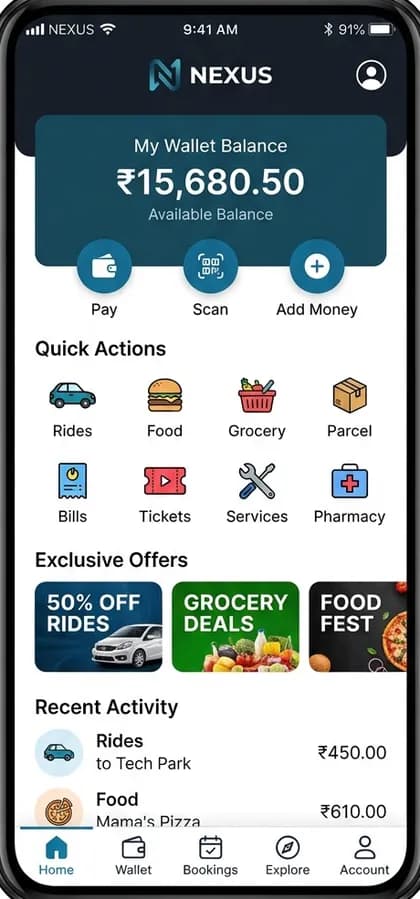
- Unified home with service tiles
- Single wallet and saved addresses
- Cross-service order history
- Loyalty points across modules
02
Partner apps
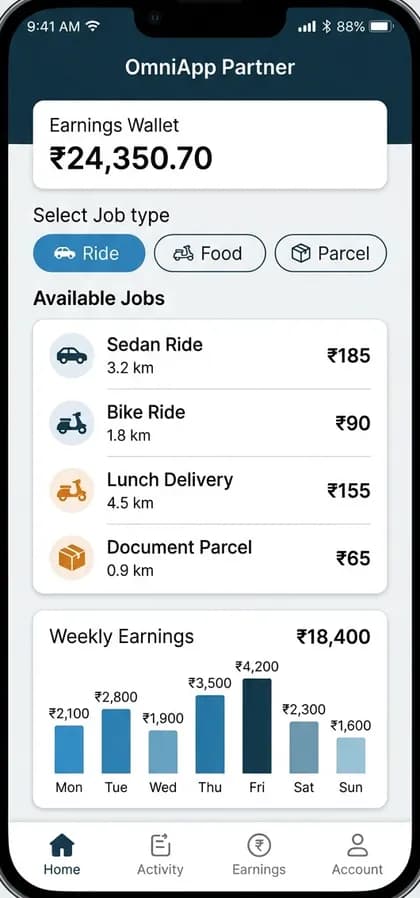
- Drivers, couriers and vendors with role-specific apps
- Shared earnings wallet
- Service-specific job flows
03
Admin panel
- Module enable/disable by city
- Commission rules per service
- Central support and refunds
- Cross-service analytics
Workflow
How a typical marketplace operations flow runs
- 1
Customer signs in once and chooses a service module
- 2
Module-specific flow handles booking, ordering or payment
- 3
Partner network for that module fulfils the job
- 4
Payment settles through the common wallet
- 5
Rewards and history update across the platform
Technology & integrations
Technical considerations
- Split payments and vendor payouts are easiest with a gateway that supports marketplace settlements; otherwise a ledger and manual payout process are required.
- A well-defined internal API per module prevents the app becoming one tangled codebase.
- Feature flags allow staged rollout by city.
- App size must be managed; consider dynamic delivery of rarely used modules.
- Wallets may require payment-licence partnerships depending on the country.
Compliance note: Stored-value wallets and payments are regulated. Partner with licensed payment providers and follow local KYC rules.
Customisation options
Make it yours
- Your brand identity, colours, typography and app icon
- Business rules for marketplace operations configurable from the admin panel
- Languages, currencies and regional tax settings
- Payment gateways and payout methods available in your country
- Commission, fee or subscription structure
- Optional modules added in later phases
Development scope
A typical first release includes the customer app, partner apps, admin panel, a backend API, cloud hosting setup and the integrations for marketplace operations. Optional modules are planned into later phases.
Factors affecting pricing
What drives the cost of a Gojek-style app
Medium-level projects typically start from ₹1.5 Lakh ($1,800). Your exact quote depends on these factors.
- Vendor management and split settlements
- Number of launch modules
- Wallet and ledger complexity
- Number of partner roles
- Localisation and multi-city rules
- Shared support tooling
Project phases
Estimated phases, testing and launch
Durations are agreed after discovery; testing, deployment and maintenance are part of every plan.
Phase 1
Discovery
Confirm the Gojek-style app business model, user roles and must-have features.
Phase 2
Design
Original user flows and interface design for each app and the admin panel.
Phase 3
Build
Mobile apps, backend APIs and marketplace operations.
Phase 4
Test
Functional, device and load testing of critical flows.
Phase 5
Launch
Store submission, cloud deployment and monitoring.
Phase 6
Improve
Maintenance and roadmap features based on real usage.
FAQs
Gojek Clone App questions
How many services should I launch with?+
Usually two or three with shared demand, such as rides plus food or parcels, then add modules once the partner network is stable.
How much does it cost to build a Gojek-style app?+
Cost depends on the roles you need (customer app, partner apps, admin panel), the depth of marketplace operations, integrations and platforms. Medium-level builds typically range from ₹4–10 Lakh ($4,800–$12,000) for multi-role apps, and from ₹1.5 Lakh ($1,800) for a focused first release; we confirm the exact quote after reviewing your requirements.
How do vendors get paid?+
Through scheduled payouts after commission is deducted, either automatically via a marketplace-capable gateway or through a reconciled payout report.
Is this an official Gojek product?+
No. CloneAppTech is an independent development company. Gojek is referenced only to describe a business model; all trademarks belong to their owners.
Can each service have its own partners?+
Yes. Drivers, restaurants and service professionals can have separate apps or roles inside one partner app.
Related
Explore related solutions
Related app models
Related categories
Development services
Next steps
Free consultation
Planning a Gojek-style app?
Tell us your market and must-have features. We'll suggest a realistic first release for your gojek clone app and the next steps.