
Online Course Marketplace Development
Building a online course marketplace means turning a familiar education & e-learning idea into software that fits your market. Success depends less on the number of screens and more on getting marketplace operations and learning delivery right from the first release.
CloneAppTech designs and builds original apps, dashboards and integrations around your brand, pricing and operating rules.
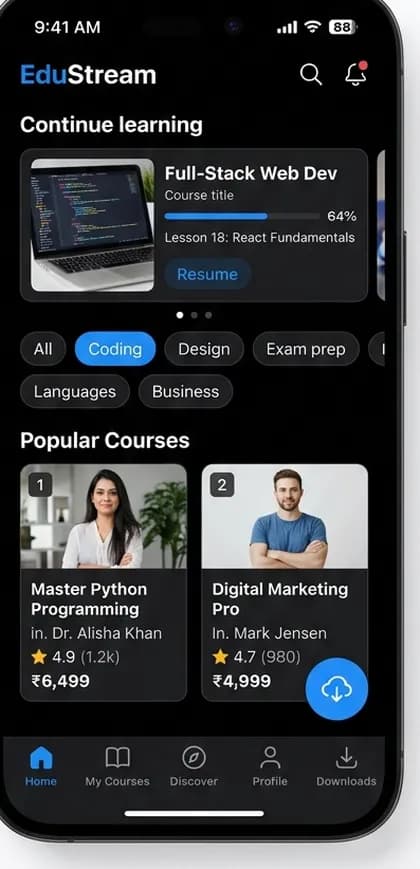
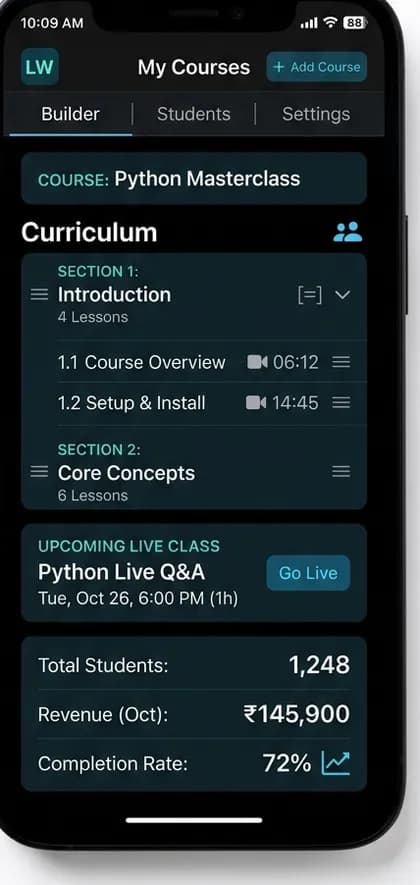
Business model
How a online course marketplace makes money
Most online course marketplace projects follow one of three models: course marketplace, subscription learning, institution software. Monthly access to a full library or exam program. The right choice depends on who owns inventory or supply, how you earn per transaction and how much operational control you want.
Course marketplace
Instructors publish courses; revenue is shared per sale.
Subscription learning
Monthly access to a full library or exam program.
Institution software
Schools, colleges and training teams license management tools.
Target audience & use cases
Who this solution is for
- Institutions and public bodies
- Industry specialists with domain expertise
- Innovators working with new technology
- Existing education & e-learning businesses replacing manual or outdated systems
Core application features
What the product needs on day one
- Vendor onboarding with document verification
- Per-vendor commission and payout rules
- Vendor-level catalogue and order dashboards
- Ratings that affect vendor visibility
- Lessons, modules and progress tracking
- Quizzes and assignments
- Live sessions with recordings
- Certificates and reports
- Video lessons
- Live classes
- Assessments
- Progress tracking
Apps & user roles
Features for every role involved
Only the roles that apply to this business model are included.
01
Learner app
- Course discovery and enrolment
- Video lessons with offline downloads
- Quizzes and progress tracking
- Certificates
02
Instructor app
- Course builder
- Live classes
- Student analytics and payouts
03
Admin panel
- Course approval
- Pricing and coupons
- Batches, fees and reports
Workflow
How a typical marketplace operations flow runs
- 1
Learner finds a course or is enrolled by an institution
- 2
Lessons unlock by schedule or progress
- 3
Quizzes and assignments are submitted
- 4
Instructor reviews performance
- 5
Certificates or results are issued
Technology & integrations
Technical considerations
- Split payments and vendor payouts are easiest with a gateway that supports marketplace settlements; otherwise a ledger and manual payout process are required.
- Protect paid video with signed URLs or DRM; plan live-class capacity with a proven video SDK.
- DRM or signed URLs protect paid video.
- Live classes need a reliable video SDK.
- Offline downloads must respect content licences.
- SCORM/xAPI support for corporate training if required.
Compliance note: Apps for children must follow child-privacy rules such as COPPA or local equivalents.
Customisation options
Make it yours
- Your brand identity, colours, typography and app icon
- Business rules for marketplace operations configurable from the admin panel
- Languages, currencies and regional tax settings
- Payment gateways and payout methods available in your country
- Commission, fee or subscription structure
- Optional modules added in later phases
Development scope
A typical first release includes the learner app, instructor app, admin panel, a backend API, cloud hosting setup and the integrations for marketplace operations and learning delivery. Optional modules are planned into later phases.
Factors affecting pricing
What drives the cost of a online course marketplace
Medium-level projects typically start from ₹1.5 Lakh ($1,800). Your exact quote depends on these factors.
- Vendor management and split settlements
- Video delivery and assessments
- Recorded vs. live delivery
- Assessment engine
- Content protection
- Institution modules
- Gamification
Project phases
Estimated phases, testing and launch
Durations are agreed after discovery; testing, deployment and maintenance are part of every plan.
Phase 1
Discovery
Confirm the online course marketplace business model, user roles and must-have features.
Phase 2
Design
Original user flows and interface design for each app and the admin panel.
Phase 3
Build
Mobile apps, backend APIs and marketplace operations, learning delivery.
Phase 4
Test
Functional, device and load testing of critical flows.
Phase 5
Launch
Store submission, cloud deployment and monitoring.
Phase 6
Improve
Maintenance and roadmap features based on real usage.
FAQs
Online Course Marketplace questions
How much does it cost to build a online course marketplace?+
Cost depends on the roles you need (learner app, instructor app, admin panel), the depth of marketplace operations, integrations and platforms. Medium-level builds typically range from ₹4–10 Lakh ($4,800–$12,000) for multi-role apps, and from ₹1.5 Lakh ($1,800) for a focused first release; we confirm the exact quote after reviewing your requirements.
How do vendors get paid?+
Through scheduled payouts after commission is deducted, either automatically via a marketplace-capable gateway or through a reconciled payout report.
Can learners study offline?+
Downloaded lessons can be stored encrypted and expire when access ends.
Can schools manage fees and attendance?+
Yes, school and college management modules cover attendance, timetables, fees and parent communication.
Related
Explore related solutions
Related app models
Development services
Next steps
Free consultation
Planning a online course marketplace?
Tell us your market and must-have features. We'll suggest a realistic first release for your online course marketplace and the next steps.