
Online Supermarket App Development
Businesses exploring a online supermarket app usually want a product that customers understand instantly while the operation behind it stays manageable. For this model, storefront and a clear admin panel shape most of the development scope.
CloneAppTech designs and builds original apps, dashboards and integrations around your brand, pricing and operating rules.
Business model
How a online supermarket app makes money
Most online supermarket app projects follow one of three models: dark-store quick commerce, marketplace for local stores, scheduled & subscription delivery. Daily milk, weekly vegetables or monthly staples delivered in planned slots. The right choice depends on who owns inventory or supply, how you earn per transaction and how much operational control you want.
Dark-store quick commerce
Own inventory in small urban warehouses, a limited SKU range and delivery radii of 2–4 km.
Marketplace for local stores
Neighbourhood shops list their stock; the platform earns commission and delivery fees.
Scheduled & subscription delivery
Daily milk, weekly vegetables or monthly staples delivered in planned slots.
Target audience & use cases
Who this solution is for
- Retailers and distributors adding a digital sales channel
- Start-ups entering local commerce
- Brands that want direct customer relationships
- Existing grocery delivery & quick commerce businesses replacing manual or outdated systems
Core application features
What the product needs on day one
- Catalogue with variants and filters
- Cart, coupons and checkout
- Order tracking and returns
- Personalised recommendations
- Serviceability check by pin code or GPS radius
- Promised delivery window shown before checkout
- Auto-assignment to the nearest available partner
- Order batching for nearby drops
- Location-based store assignment
- Inventory sync with POS or ERP
- Substitution rules
- Delivery slot capacity
Apps & user roles
Features for every role involved
Only the roles that apply to this business model are included.
01
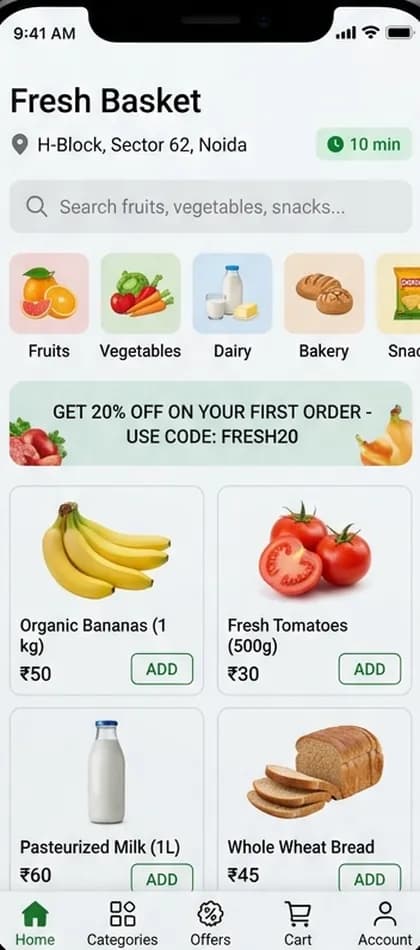
Customer app
- Category browsing, search and reorder
- Real-time stock and substitution preferences
- Slot or instant delivery checkout
- Live order and rider tracking
02
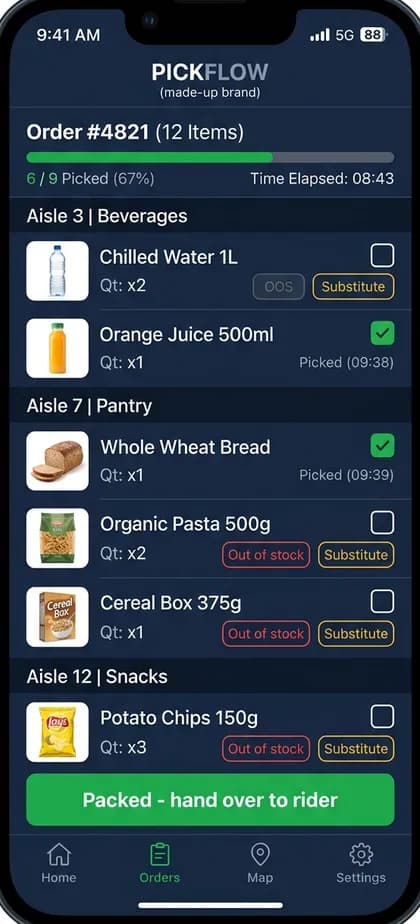
Store / picker app
- Order queue with pick lists by aisle
- Out-of-stock marking and substitutions
- Packing confirmation and handover
03
Delivery partner app
- Batching and route guidance
- Cash-on-delivery reconciliation
- Proof of delivery
04
Admin panel
- Dark-store and zone management
- Pricing, offers and inventory sync
- Rider payouts and SLA reports
Workflow
How a typical storefront flow runs
- 1
Customer builds a basket from the nearest store's live stock
- 2
Order is routed to a store and a picking task is created
- 3
Picker scans items and confirms substitutions
- 4
Rider is assigned and collects the packed order
- 5
Delivery is confirmed and ratings are collected
Technology & integrations
Technical considerations
- Search quality and image performance have the largest impact on conversion.
- Fast-delivery promises depend on accurate store radius, prep time and rider availability data; the promise should be calculated, not hard-coded.
- Accurate stock sync is the hardest part; plan integration with the store's inventory system early.
- Geo-fenced serviceability zones and dynamic delivery fees.
- Push notifications for order states and substitution approvals.
- Offline-tolerant picker app for warehouse Wi-Fi blind spots.
Customisation options
Make it yours
- Your brand identity, colours, typography and app icon
- Business rules for storefront configurable from the admin panel
- Languages, currencies and regional tax settings
- Payment gateways and payout methods available in your country
- Commission, fee or subscription structure
- Optional modules added in later phases
Development scope
A typical first release includes the customer app, store / picker app, delivery partner app, admin panel, a backend API, cloud hosting setup and the integrations for storefront and rapid fulfilment. Optional modules are planned into later phases.
Factors affecting pricing
What drives the cost of a online supermarket app
Medium-level projects typically start from ₹1.5 Lakh ($1,800). Your exact quote depends on these factors.
- Catalogue, search and checkout
- Real-time dispatch and SLA monitoring
- Number of stores, zones and SKUs
- Picker and dark-store tooling
- Inventory/POS integration depth
- Delivery batching and routing logic
- Subscription and wallet features
Project phases
Estimated phases, testing and launch
Durations are agreed after discovery; testing, deployment and maintenance are part of every plan.
Phase 1
Discovery
Confirm the online supermarket app business model, user roles and must-have features.
Phase 2
Design
Original user flows and interface design for each app and the admin panel.
Phase 3
Build
Mobile apps, backend APIs and storefront, rapid fulfilment.
Phase 4
Test
Functional, device and load testing of critical flows.
Phase 5
Launch
Store submission, cloud deployment and monitoring.
Phase 6
Improve
Maintenance and roadmap features based on real usage.
FAQs
Online Supermarket App questions
How much does it cost to build a online supermarket app?+
Cost depends on the roles you need (customer app, store / picker app, delivery partner app, admin panel), the depth of storefront, integrations and platforms. Medium-level builds typically range from ₹4–10 Lakh ($4,800–$12,000) for multi-role apps, and from ₹1.5 Lakh ($1,800) for a focused first release; we confirm the exact quote after reviewing your requirements.
Can the app sync with my inventory?+
Yes, through your POS, ERP or e-commerce platform's API.
Can delivery time promises change by area?+
Yes. Promises are calculated per zone from distance, current load and partner availability, and can be switched to slot delivery when capacity is low.
How are substitutions handled?+
Customers set preferences at checkout, pickers propose replacements in their app, and the customer approves through a notification before dispatch.
Related
Explore related solutions
Related app models
Related categories
Development services
Next steps
Free consultation
Planning a online supermarket app?
Tell us your market and must-have features. We'll suggest a realistic first release for your online supermarket app and the next steps.