
Poshmark Clone App Development
Businesses exploring a Poshmark-style app usually want a product that customers understand instantly while the operation behind it stays manageable. For this model, money movement and a clear admin panel shape most of the development scope.
It is inspired by the publicly known Poshmark business model, but it is not affiliated with, endorsed by or a copy of Poshmark. CloneAppTech designs and builds original apps, dashboards and integrations around your brand, pricing and operating rules.
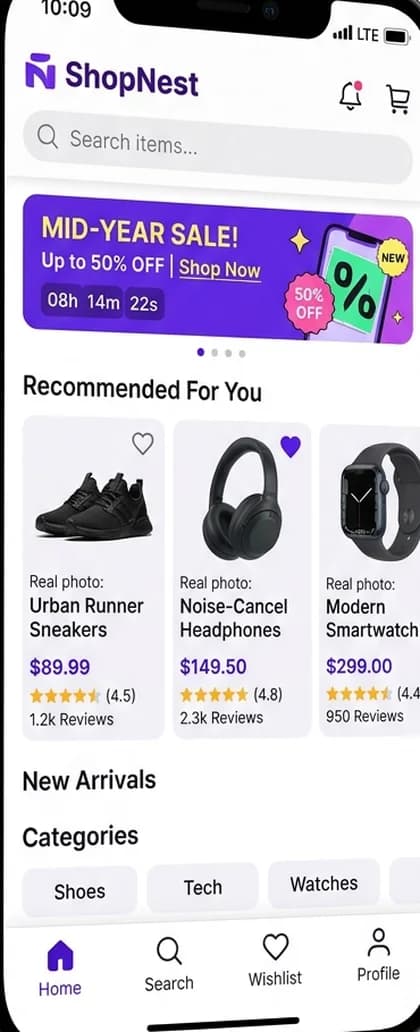

Business model
How a Poshmark-style app makes money
Most Poshmark-style app projects follow one of three models: free listings with paid boosts, vertical marketplace, managed c2c with escrow. Platform holds payment until the buyer confirms receipt. The right choice depends on who owns inventory or supply, how you earn per transaction and how much operational control you want.
Free listings with paid boosts
Users list for free and pay to feature or bump listings.
Vertical marketplace
Cars, phones, fashion or furniture with inspection and certified resale.
Managed C2C with escrow
Platform holds payment until the buyer confirms receipt.
Target audience & use cases
Who this solution is for
- Retailers and distributors adding a digital sales channel
- Start-ups entering local commerce
- Brands that want direct customer relationships
- Existing classifieds & reselling businesses replacing manual or outdated systems
Core application features
What the product needs on day one
- KYC-based onboarding
- PIN or biometric authorisation
- Transaction ledger with statements
- Refunds, reversals and dispute flows
- Role-based dashboards
- Configurable records and custom fields
- Approval workflows
- Exports and scheduled reports
- Geo-radius search
- Real-time chat
- Listing moderation
- Paid boosts
Apps & user roles
Features for every role involved
Only the roles that apply to this business model are included.
01
Buyer app
- Location-based browsing
- Saved searches and alerts
- In-app chat and offers
- Report and block tools
02
Seller app
- Photo-first listing creation
- Price suggestions and edits
- Boost and featured listing purchases
- Listing performance
03
Admin panel
- Moderation queue and keyword filters
- Category and attribute setup
- Paid plans and boosts
- Fraud and spam controls
Workflow
How a typical money movement flow runs
- 1
Seller photographs an item and publishes a listing
- 2
Listing passes automatic and manual moderation
- 3
Buyers discover it by location and filters
- 4
Buyer and seller chat and agree terms
- 5
Item is handed over or shipped with optional escrow
Technology & integrations
Technical considerations
- Money movement must run on licensed partner rails; the app layer handles UX, ledgering and reconciliation.
- Integration with accounting, ERP or existing databases usually decides scope; offline mode helps field teams.
- Image moderation and duplicate detection reduce spam at scale.
- Chat should support media, offers and safety prompts.
- Search indexes must update quickly as listings sell.
- Location privacy: show approximate areas, not exact addresses.
Customisation options
Make it yours
- Your brand identity, colours, typography and app icon
- Business rules for money movement configurable from the admin panel
- Languages, currencies and regional tax settings
- Payment gateways and payout methods available in your country
- Commission, fee or subscription structure
- Optional modules added in later phases
Development scope
A typical first release includes the buyer app, seller app, admin panel, a backend API, cloud hosting setup and the integrations for money movement and operations console. Optional modules are planned into later phases.
Factors affecting pricing
What drives the cost of a Poshmark-style app
Medium-level projects typically start from ₹1.5 Lakh ($1,800). Your exact quote depends on these factors.
- Payment partner integration and reconciliation
- Roles, workflows and integrations
- General vs. vertical attributes
- Moderation tooling
- Chat and media
- Escrow or inspection services
- Monetisation model
Project phases
Estimated phases, testing and launch
Durations are agreed after discovery; testing, deployment and maintenance are part of every plan.
Phase 1
Discovery
Confirm the Poshmark-style app business model, user roles and must-have features.
Phase 2
Design
Original user flows and interface design for each app and the admin panel.
Phase 3
Build
Mobile apps, backend APIs and money movement, operations console.
Phase 4
Test
Functional, device and load testing of critical flows.
Phase 5
Launch
Store submission, cloud deployment and monitoring.
Phase 6
Improve
Maintenance and roadmap features based on real usage.
FAQs
Poshmark Clone App questions
How much does it cost to build a Poshmark-style app?+
Cost depends on the roles you need (buyer app, seller app, admin panel), the depth of money movement, integrations and platforms. Medium-level builds typically range from ₹4–10 Lakh ($4,800–$12,000) for multi-role apps, and from ₹1.5 Lakh ($1,800) for a focused first release; we confirm the exact quote after reviewing your requirements.
Do I need a licence?+
Moving or storing money usually needs a licence or a licensed partner. We build on top of partners you contract with.
Can it replace our spreadsheets?+
Yes — we map your current sheets to structured records, permissions and reports.
Is this an official Poshmark product?+
No. CloneAppTech is an independent development company. Poshmark is referenced only to describe a business model; all trademarks belong to their owners.
Can I focus on one category?+
Yes, vertical classifieds such as used cars or phones often convert better with specialised attributes.
Related
Explore related solutions
Related app models
Related categories
Development services
Next steps
Free consultation
Planning a Poshmark-style app?
Tell us your market and must-have features. We'll suggest a realistic first release for your poshmark clone app and the next steps.