Remote Patient Monitoring App Development
A remote patient monitoring app sits within healthcare & telemedicine and focuses on doctor booking, teleconsultation, records and care-delivery apps. The product has to work for every role involved — patient app, doctor app, clinic / admin panel — and its most important capability is clinical data handling.
CloneAppTech designs and builds original apps, dashboards and integrations around your brand, pricing and operating rules.

Business model
How a remote patient monitoring app makes money
Most remote patient monitoring app projects follow one of three models: doctor marketplace, provider-owned app, subscription care. Consultation fees with platform commission. The right choice depends on who owns inventory or supply, how you earn per transaction and how much operational control you want.
Doctor marketplace
Consultation fees with platform commission.
Provider-owned app
A hospital or clinic chain digitises its own services.
Subscription care
Membership plans for unlimited consults or chronic-care programs.
Target audience & use cases
Who this solution is for
- Clinics, studios and service providers
- Lifestyle brands and wellness businesses
- Start-ups serving families and personal care
- Existing healthcare & telemedicine businesses replacing manual or outdated systems
Core application features
What the product needs on day one
- Consent capture and records access logs
- Prescription and report storage
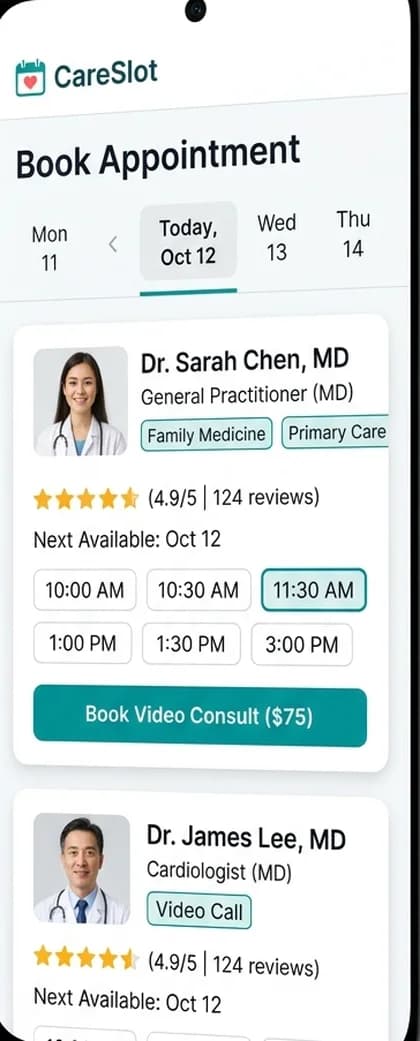
- Teleconsult or appointment flows
- Role-based access for clinicians
- Role-based dashboards
- Configurable records and custom fields
- Approval workflows
- Exports and scheduled reports
- Slot scheduling
- Secure video consultation
- E-prescriptions
- Medical records
Apps & user roles
Features for every role involved
Only the roles that apply to this business model are included.
01
Patient app
- Search by speciality and availability
- Book in-clinic or video consults
- Prescriptions and reports
- Family member profiles
02
Doctor app
- Schedule and slot management
- Video consultation and notes
- E-prescription
- Earnings
03
Clinic / admin panel
- Doctor onboarding and credentials
- Billing and invoices
- Patient records access control
- Reports
Workflow
How a typical clinical data handling flow runs
- 1
Patient chooses a doctor and slot
- 2
Payment and consent are captured
- 3
Consultation happens in clinic or by video
- 4
Doctor records notes and issues a prescription
- 5
Follow-ups, lab tests or reminders are scheduled
Technology & integrations
Technical considerations
- Encrypt clinical data, keep audit trails and align hosting with applicable health-data regulations.
- Integration with accounting, ERP or existing databases usually decides scope; offline mode helps field teams.
- Encrypt health data at rest and in transit; restrict access by role.
- Video consultation via a reliable WebRTC provider.
- Interoperability (HL7/FHIR) if connecting to hospital systems.
- Audit logs for every record access.
Compliance note: Healthcare software may fall under regulations such as HIPAA, GDPR or local telemedicine guidelines. Legal review is recommended before launch.
Customisation options
Make it yours
- Your brand identity, colours, typography and app icon
- Business rules for clinical data handling configurable from the admin panel
- Languages, currencies and regional tax settings
- Payment gateways and payout methods available in your country
- Commission, fee or subscription structure
- Optional modules added in later phases
Development scope
A typical first release includes the patient app, doctor app, clinic / admin panel, a backend API, cloud hosting setup and the integrations for clinical data handling and operations console. Optional modules are planned into later phases.
Factors affecting pricing
What drives the cost of a remote patient monitoring app
Medium-level projects typically start from ₹1.5 Lakh ($1,800). Your exact quote depends on these factors.
- Security, audit and integrations
- Roles, workflows and integrations
- Telemedicine vs. booking only
- EHR depth
- Integrations with labs or HIS
- Compliance requirements
- Multi-clinic management
Project phases
Estimated phases, testing and launch
Durations are agreed after discovery; testing, deployment and maintenance are part of every plan.
Phase 1
Discovery
Confirm the remote patient monitoring app business model, user roles and must-have features.
Phase 2
Design
Original user flows and interface design for each app and the admin panel.
Phase 3
Build
Mobile apps, backend APIs and clinical data handling, operations console.
Phase 4
Test
Functional, device and load testing of critical flows.
Phase 5
Launch
Store submission, cloud deployment and monitoring.
Phase 6
Improve
Maintenance and roadmap features based on real usage.
FAQs
Remote Patient Monitoring App questions
How much does it cost to build a remote patient monitoring app?+
Cost depends on the roles you need (patient app, doctor app, clinic / admin panel), the depth of clinical data handling, integrations and platforms. Medium-level builds typically range from ₹4–10 Lakh ($4,800–$12,000) for multi-role apps, and from ₹1.5 Lakh ($1,800) for a focused first release; we confirm the exact quote after reviewing your requirements.
Is the app compliant with health regulations?+
Compliance depends on your processes as well as software. We build the technical safeguards and recommend legal review.
Can it replace our spreadsheets?+
Yes — we map your current sheets to structured records, permissions and reports.
Is telemedicine allowed in my country?+
Most countries permit it under specific guidelines; requirements for prescriptions and doctor registration vary.
Related
Explore related solutions
Related app models
Related categories
Development services
Next steps
Free consultation
Planning a remote patient monitoring app?
Tell us your market and must-have features. We'll suggest a realistic first release for your remote patient monitoring app and the next steps.