
Shopify-Style Shopping App Development
A Shopify-style shopping app sits within e-commerce & shopping and focuses on single-brand stores, multi-vendor marketplaces and social commerce. The product has to work for every role involved — shopper app, seller panel, admin panel — and its most important capability is storefront.
It is inspired by the publicly known Shopify business model, but it is not affiliated with, endorsed by or a copy of Shopify. CloneAppTech designs and builds original apps, dashboards and integrations around your brand, pricing and operating rules.
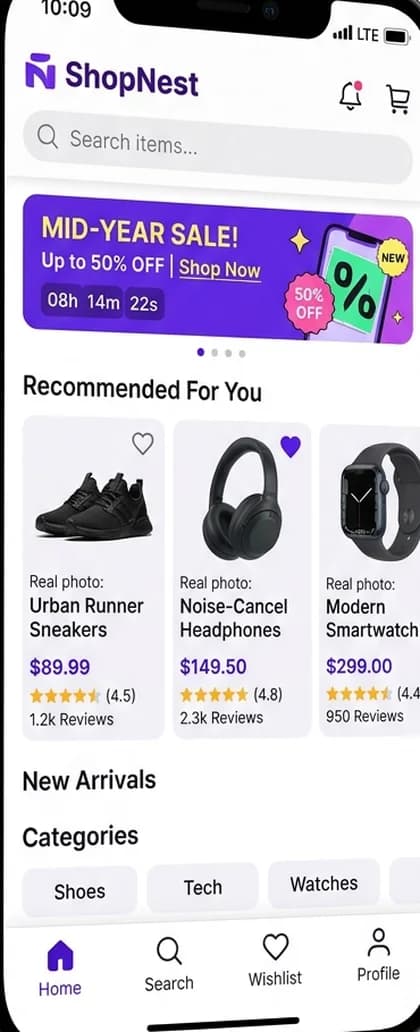

Business model
How a Shopify-style shopping app makes money
Most Shopify-style shopping app projects follow one of three models: multi-vendor marketplace, d2c / single brand, social and reseller commerce. Sellers list products; you earn commission and listing or advertising fees. The right choice depends on who owns inventory or supply, how you earn per transaction and how much operational control you want.
Multi-vendor marketplace
Sellers list products; you earn commission and listing or advertising fees.
D2C / single brand
Your own catalogue with higher margins and direct customer data.
Social and reseller commerce
Resellers or creators share products and earn margins or commission.
Target audience & use cases
Who this solution is for
- Retailers and distributors adding a digital sales channel
- Start-ups entering local commerce
- Brands that want direct customer relationships
- Existing e-commerce & shopping businesses replacing manual or outdated systems
Core application features
What the product needs on day one
- Catalogue with variants and filters
- Cart, coupons and checkout
- Order tracking and returns
- Personalised recommendations
- Faceted search
- Variant and SKU management
- Shipping aggregator integration
- Return and refund workflow
- Seller settlements
- Recommendation widgets
Apps & user roles
Features for every role involved
Only the roles that apply to this business model are included.
01
Shopper app
- Search with filters and sorting
- Product variants and reviews
- Wishlist, cart and saved addresses
- Order tracking and returns
02
Seller panel
- Catalogue and inventory management
- Order processing and shipping labels
- Payouts and performance metrics
03
Admin panel
- Seller approval and commission
- Category and attribute management
- Promotions, banners and coupons
- Returns and dispute handling
Workflow
How a typical storefront flow runs
- 1
Shopper searches and compares products
- 2
Cart is checked out with chosen payment method
- 3
Seller or warehouse packs the order
- 4
Shipping partner picks up and tracking updates flow back
- 5
Delivery, returns window and seller payout follow
Technology & integrations
Technical considerations
- Search quality and image performance have the largest impact on conversion.
- Search quality drives revenue; consider a dedicated search engine for large catalogues.
- Shipping and tax rules differ by region and should be configurable.
- Image optimisation and caching for fast product pages.
- Payment gateway choice affects settlement times for sellers.
Customisation options
Make it yours
- Your brand identity, colours, typography and app icon
- Business rules for storefront configurable from the admin panel
- Languages, currencies and regional tax settings
- Payment gateways and payout methods available in your country
- Commission, fee or subscription structure
- Optional modules added in later phases
Development scope
A typical first release includes the shopper app, seller panel, admin panel, a backend API, cloud hosting setup and the integrations for storefront. Optional modules are planned into later phases.
Factors affecting pricing
What drives the cost of a Shopify-style shopping app
Medium-level projects typically start from ₹1.5 Lakh ($1,800). Your exact quote depends on these factors.
- Catalogue, search and checkout
- Catalogue size and attribute complexity
- Single vs. multi-vendor
- Shipping and ERP integrations
- Live or social commerce features
- Cross-border currencies and duties
Project phases
Estimated phases, testing and launch
Durations are agreed after discovery; testing, deployment and maintenance are part of every plan.
Phase 1
Discovery
Confirm the Shopify-style shopping app business model, user roles and must-have features.
Phase 2
Design
Original user flows and interface design for each app and the admin panel.
Phase 3
Build
Mobile apps, backend APIs and storefront.
Phase 4
Test
Functional, device and load testing of critical flows.
Phase 5
Launch
Store submission, cloud deployment and monitoring.
Phase 6
Improve
Maintenance and roadmap features based on real usage.
FAQs
Shopify-Style Shopping App questions
How much does it cost to build a Shopify-style shopping app?+
Cost depends on the roles you need (shopper app, seller panel, admin panel), the depth of storefront, integrations and platforms. Medium-level builds typically range from ₹4–10 Lakh ($4,800–$12,000) for multi-role apps, and from ₹1.5 Lakh ($1,800) for a focused first release; we confirm the exact quote after reviewing your requirements.
Can the app sync with my inventory?+
Yes, through your POS, ERP or e-commerce platform's API.
Is this an official Shopify product?+
No. CloneAppTech is an independent development company. Shopify is referenced only to describe a business model; all trademarks belong to their owners.
Should I build an app or start with a website?+
Many brands launch both together. Apps help with repeat purchases and notifications; the web helps discovery and SEO.
Related
Explore related solutions
Related app models
Related categories
Development services
Next steps
Free consultation
Planning a Shopify-style shopping app?
Tell us your market and must-have features. We'll suggest a realistic first release for your shopify-style shopping app and the next steps.