Urban Company Clone App Development
An Urban Company-style app is a managed home-services marketplace: the platform defines services and prices, trains and verifies professionals and guarantees quality. Customers book fixed-price services in time slots instead of collecting quotes.
It is inspired by the publicly known Urban Company business model, but it is not affiliated with, endorsed by or a copy of Urban Company. CloneAppTech designs and builds original apps, dashboards and integrations around your brand, pricing and operating rules.

Business model
How a Urban Company-style app makes money
The platform keeps a commission on each job and may sell kits or products to professionals. Subscriptions and annual maintenance plans add recurring revenue.
Managed marketplace
Platform sets prices, trains professionals and guarantees quality.
Open marketplace
Professionals quote; customers compare and choose.
Single-company booking app
A cleaning or repair business digitises its own bookings.
Target audience & use cases
Who this solution is for
- Home-services start-ups
- Facility management companies
- Beauty and wellness networks
Core application features
What the product needs on day one
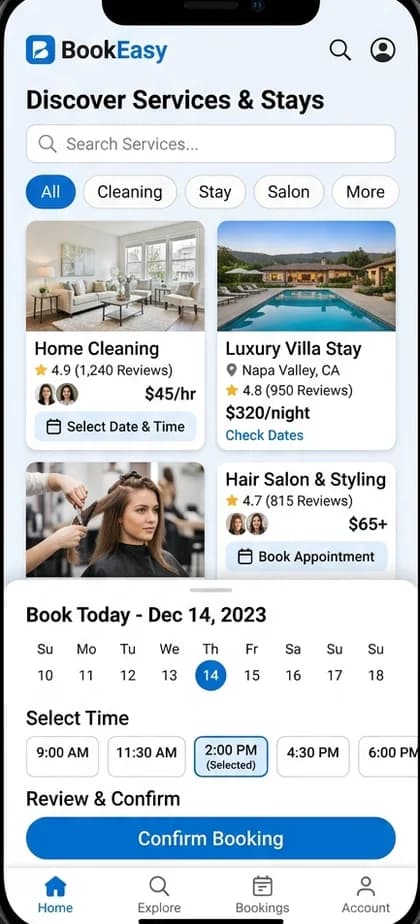
- Real-time slot availability
- Buffer times and capacity limits
- Reminders by push, SMS or WhatsApp
- Reschedule and cancellation policies
- Slot and capacity engine
- Skill-based assignment
- Add-on and parts approval
- Background verification
- Warranty and re-service
- Subscription plans
Apps & user roles
Features for every role involved
Only the roles that apply to this business model are included.
01
Customer app
- Service catalogue with clear pricing
- Slot selection and address
- Professional profile and rating
- Rescheduling and support
02
Professional app
- Job requests and calendar
- Navigation and job checklists
- Before/after photos
- Earnings and payouts
03
Admin panel
- Professional verification and training status
- Service pricing by city
- Slot capacity
- Complaints and re-work
Workflow
How a typical scheduling engine flow runs
- 1
Customer selects a service and preferred slot
- 2
System assigns or broadcasts the job to qualified professionals
- 3
Professional travels and completes the checklist
- 4
Customer approves extra parts or charges in-app
- 5
Payment, rating and warranty period are recorded
Technology & integrations
Technical considerations
- Calendar sync with Google or Outlook and time-zone handling prevent double bookings for multi-location businesses.
- Calendar logic must handle travel time between jobs.
- Photo uploads for job evidence need storage and compression.
- Partner app should work on low-end Android devices.
- Price estimates vary by property size; design flexible pricing forms.
Customisation options
Make it yours
- Your brand identity, colours, typography and app icon
- Business rules for scheduling engine configurable from the admin panel
- Languages, currencies and regional tax settings
- Payment gateways and payout methods available in your country
- Commission, fee or subscription structure
- Optional modules added in later phases
Development scope
A typical first release includes the customer app, professional app, admin panel, a backend API, cloud hosting setup and the integrations for scheduling engine. Optional modules are planned into later phases.
Factors affecting pricing
What drives the cost of a Urban Company-style app
Medium-level projects typically start from ₹1.5 Lakh ($1,800). Your exact quote depends on these factors.
- Slot engine and reminders
- Number of service types
- Quote vs. fixed-price flows
- Scheduling sophistication
- Partner onboarding and KYC
- Subscription and AMC plans
Project phases
Estimated phases, testing and launch
Durations are agreed after discovery; testing, deployment and maintenance are part of every plan.
Phase 1
Discovery
Confirm the Urban Company-style app business model, user roles and must-have features.
Phase 2
Design
Original user flows and interface design for each app and the admin panel.
Phase 3
Build
Mobile apps, backend APIs and scheduling engine.
Phase 4
Test
Functional, device and load testing of critical flows.
Phase 5
Launch
Store submission, cloud deployment and monitoring.
Phase 6
Improve
Maintenance and roadmap features based on real usage.
FAQs
Urban Company Clone App questions
Can professionals be trained through the app?+
Yes, with training content, assessments and a certification status that controls which jobs they receive.
How much does it cost to build a Urban Company-style app?+
Cost depends on the roles you need (customer app, professional app, admin panel), the depth of scheduling engine, integrations and platforms. Medium-level builds typically range from ₹4–10 Lakh ($4,800–$12,000) for multi-role apps, and from ₹1.5 Lakh ($1,800) for a focused first release; we confirm the exact quote after reviewing your requirements.
Can I reduce no-shows?+
Automated reminders, deposits and cancellation windows are the most effective combination.
Is this an official Urban Company product?+
No. CloneAppTech is an independent development company. Urban Company is referenced only to describe a business model; all trademarks belong to their owners.
Can I sell annual maintenance contracts?+
Yes, recurring plans can schedule visits automatically and bill monthly or yearly.
Related
Explore related solutions
Related app models
Development services
Next steps
Free consultation
Planning a Urban Company-style app?
Tell us your market and must-have features. We'll suggest a realistic first release for your urban company clone app and the next steps.