
Zalo-Style Super App Development
Businesses exploring a Zalo-style super app usually want a product that customers understand instantly while the operation behind it stays manageable. For this model, marketplace operations and a clear admin panel shape most of the development scope.
It is inspired by the publicly known Zalo business model, but it is not affiliated with, endorsed by or a copy of Zalo. CloneAppTech designs and builds original apps, dashboards and integrations around your brand, pricing and operating rules.
Business model
How a Zalo-style super app makes money
Most Zalo-style super app projects follow one of three models: mobility-led super app, payments-led super app, regional services aggregator. Local vendors and service providers onboard into multiple categories. The right choice depends on who owns inventory or supply, how you earn per transaction and how much operational control you want.
Mobility-led super app
Rides form the daily habit; delivery and payments are cross-sold.
Payments-led super app
A wallet or UPI app adds commerce, tickets and bill payments.
Regional services aggregator
Local vendors and service providers onboard into multiple categories.
Target audience & use cases
Who this solution is for
- Operators digitising an existing service
- Mobility and service start-ups launching city by city
- Enterprises managing transport or field teams
- Existing super apps & multi-service businesses replacing manual or outdated systems
Core application features
What the product needs on day one
- Vendor onboarding with document verification
- Per-vendor commission and payout rules
- Vendor-level catalogue and order dashboards
- Ratings that affect vendor visibility
- Modular service architecture
- Shared wallet and ledger
- Mini-app or module framework
- Unified notifications
- City-level configuration
- Partner multi-role support
Apps & user roles
Features for every role involved
Only the roles that apply to this business model are included.
01
Customer app
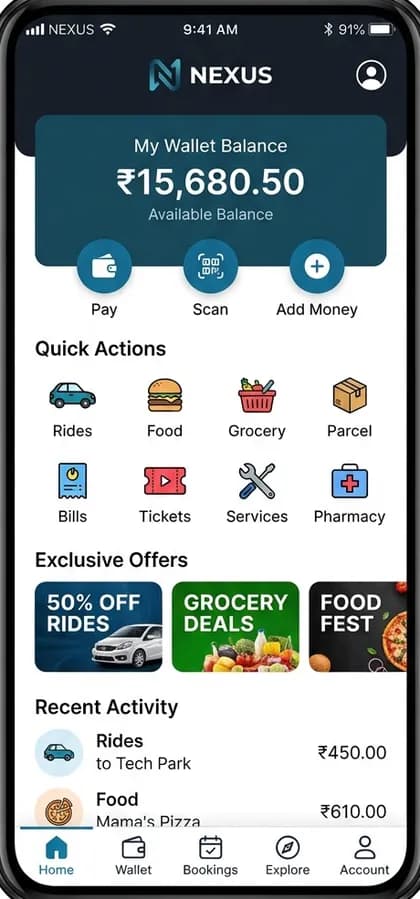
- Unified home with service tiles
- Single wallet and saved addresses
- Cross-service order history
- Loyalty points across modules
02
Partner apps
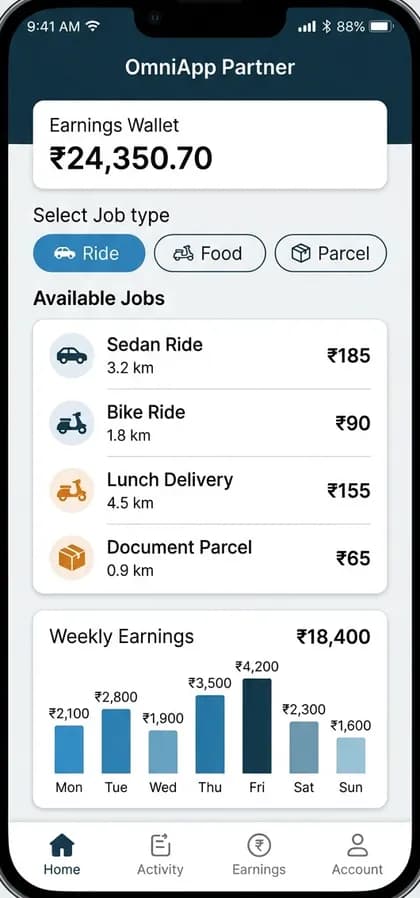
- Drivers, couriers and vendors with role-specific apps
- Shared earnings wallet
- Service-specific job flows
03
Admin panel
- Module enable/disable by city
- Commission rules per service
- Central support and refunds
- Cross-service analytics
Workflow
How a typical marketplace operations flow runs
- 1
Customer signs in once and chooses a service module
- 2
Module-specific flow handles booking, ordering or payment
- 3
Partner network for that module fulfils the job
- 4
Payment settles through the common wallet
- 5
Rewards and history update across the platform
Technology & integrations
Technical considerations
- Split payments and vendor payouts are easiest with a gateway that supports marketplace settlements; otherwise a ledger and manual payout process are required.
- A well-defined internal API per module prevents the app becoming one tangled codebase.
- Feature flags allow staged rollout by city.
- App size must be managed; consider dynamic delivery of rarely used modules.
- Wallets may require payment-licence partnerships depending on the country.
Compliance note: Stored-value wallets and payments are regulated. Partner with licensed payment providers and follow local KYC rules.
Customisation options
Make it yours
- Your brand identity, colours, typography and app icon
- Business rules for marketplace operations configurable from the admin panel
- Languages, currencies and regional tax settings
- Payment gateways and payout methods available in your country
- Commission, fee or subscription structure
- Optional modules added in later phases
Development scope
A typical first release includes the customer app, partner apps, admin panel, a backend API, cloud hosting setup and the integrations for marketplace operations. Optional modules are planned into later phases.
Factors affecting pricing
What drives the cost of a Zalo-style super app
Medium-level projects typically start from ₹1.5 Lakh ($1,800). Your exact quote depends on these factors.
- Vendor management and split settlements
- Number of launch modules
- Wallet and ledger complexity
- Number of partner roles
- Localisation and multi-city rules
- Shared support tooling
Project phases
Estimated phases, testing and launch
Durations are agreed after discovery; testing, deployment and maintenance are part of every plan.
Phase 1
Discovery
Confirm the Zalo-style super app business model, user roles and must-have features.
Phase 2
Design
Original user flows and interface design for each app and the admin panel.
Phase 3
Build
Mobile apps, backend APIs and marketplace operations.
Phase 4
Test
Functional, device and load testing of critical flows.
Phase 5
Launch
Store submission, cloud deployment and monitoring.
Phase 6
Improve
Maintenance and roadmap features based on real usage.
FAQs
Zalo-Style Super App questions
How much does it cost to build a Zalo-style super app?+
Cost depends on the roles you need (customer app, partner apps, admin panel), the depth of marketplace operations, integrations and platforms. Medium-level builds typically range from ₹4–10 Lakh ($4,800–$12,000) for multi-role apps, and from ₹1.5 Lakh ($1,800) for a focused first release; we confirm the exact quote after reviewing your requirements.
How do vendors get paid?+
Through scheduled payouts after commission is deducted, either automatically via a marketplace-capable gateway or through a reconciled payout report.
Is this an official Zalo product?+
No. CloneAppTech is an independent development company. Zalo is referenced only to describe a business model; all trademarks belong to their owners.
Is a wallet mandatory?+
No, but a shared wallet simplifies refunds and cross-service rewards. Regulatory requirements apply to stored value.
Related
Explore related solutions
Related app models
Related categories
Development services
Next steps
Free consultation
Planning a Zalo-style super app?
Tell us your market and must-have features. We'll suggest a realistic first release for your zalo-style super app and the next steps.